Abacus AI Review: Features, Pricing, and Honest Limitations
Abacus AI bundles multi-model chat, agents, and infrastructure into one subscription. Here's what it actually delivers and where it falls short.
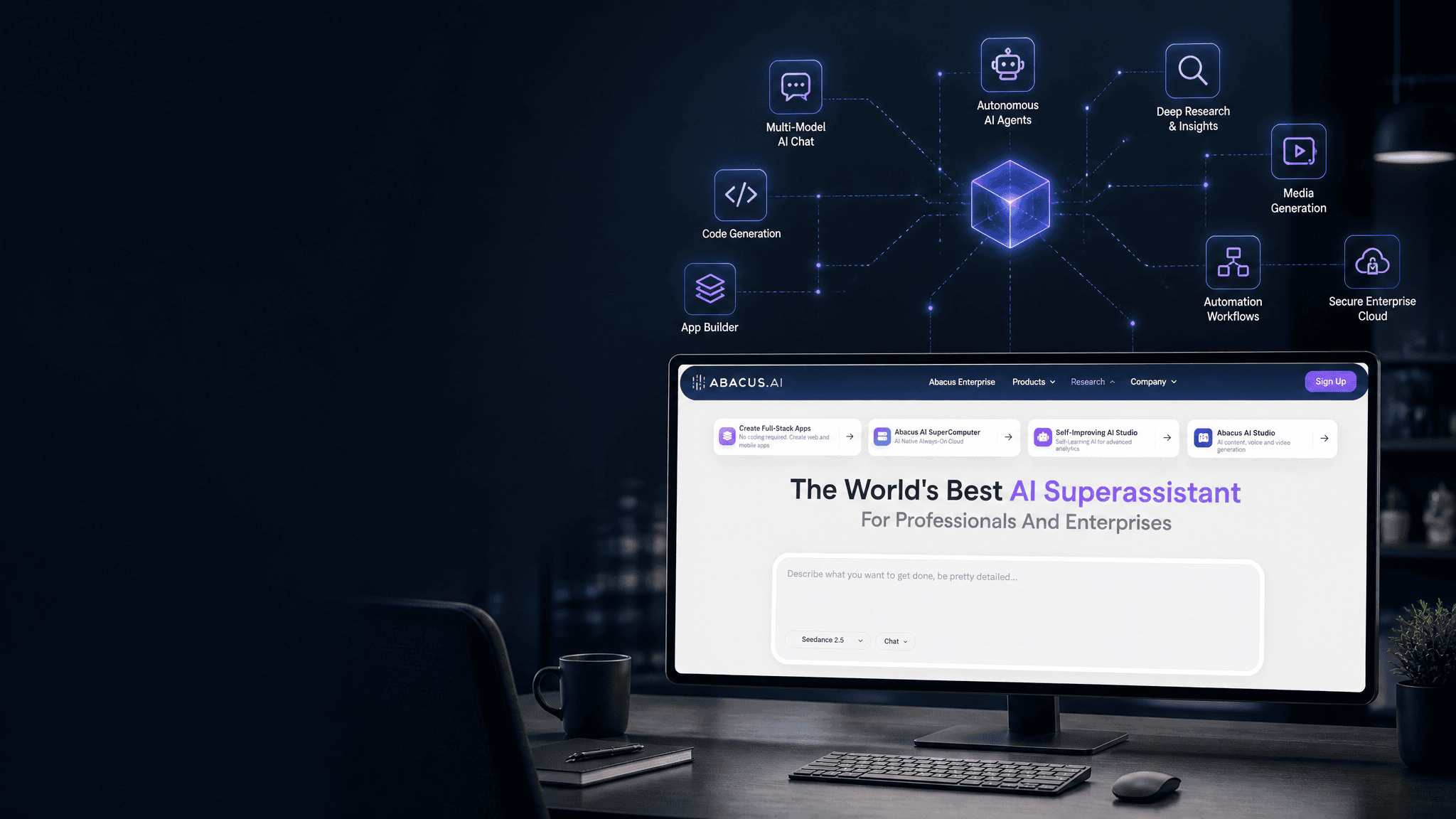
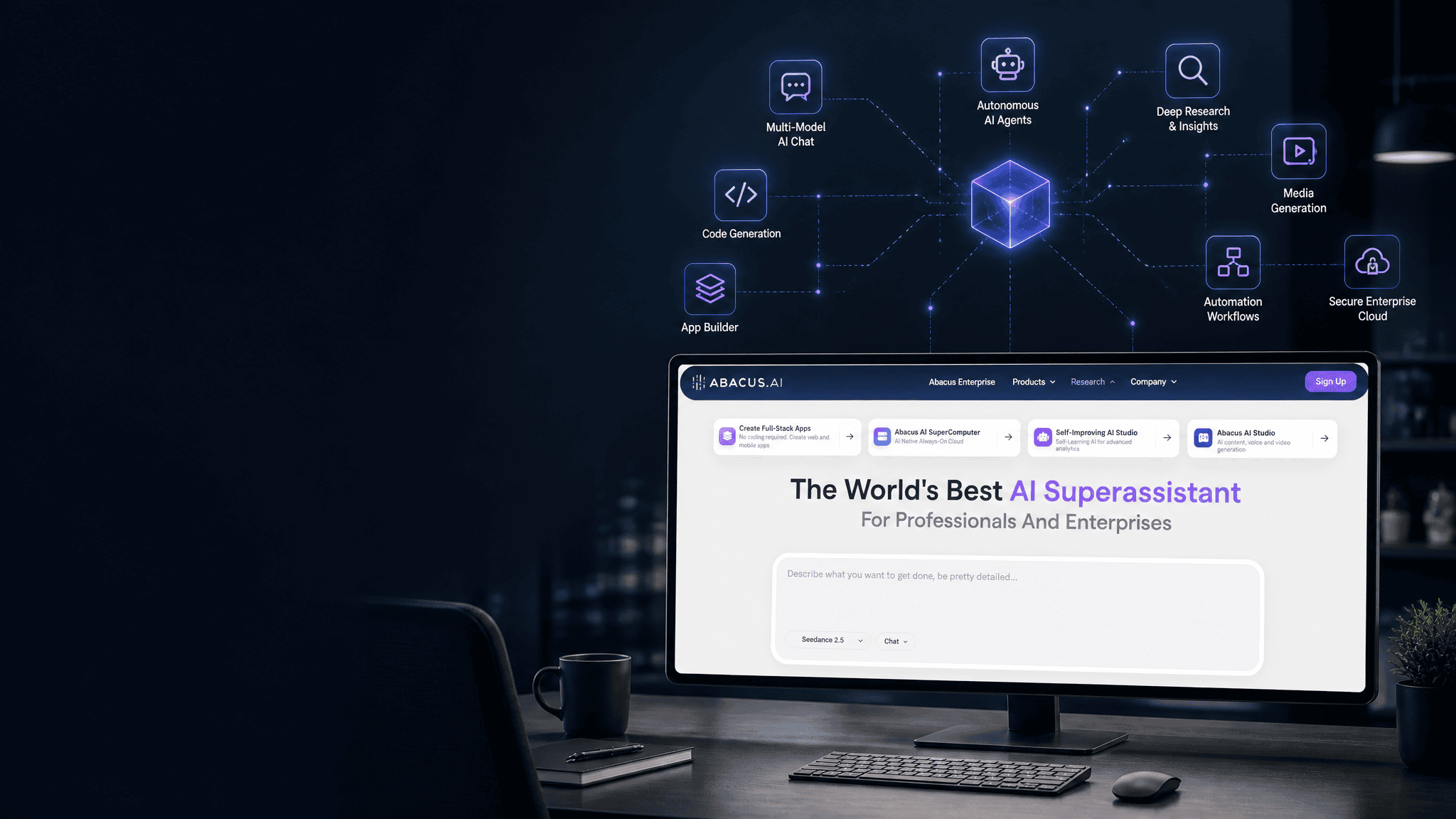
This article covers everything a serious buyer needs to know about Abacus AI — what it includes, how the pricing actually works once credits enter the picture, where it performs well, and where it still needs work. If you have been paying for ChatGPT, Claude, and something else simultaneously, this review will help you decide whether Abacus AI consolidates that cost meaningfully or just adds another subscription to the pile.
Abacus AI Review: The Verdict at a Glance
- What it is: A broad AI platform combining multi-model chat, general-purpose agents, app building, coding tools, creative generation, personal agents, API routing, cloud infrastructure, and a separately scoped enterprise platform.
- Best for: Developers, founders, analysts, agencies, operations teams, researchers, and professionals who regularly use several types of AI tools.
- Published self-serve price range: $7 for the first month, then $10 monthly for Basic; $20 monthly for Pro. Enterprise pricing reportedly starts at $5,000 per month — organizational buyers should request a current quote.
- Biggest strength: The unusually broad bundle can consolidate several AI workflows into one account at a price that undercuts most individual subscriptions.
- Biggest weakness: The low subscription price does not tell you how much practical work you can complete. Credits, model restrictions, and agent reliability issues make the true cost harder to forecast than the checkout page implies.
Abacus AI is one of the more ambitious AI subscriptions on the market right now. The consumer-facing service is not merely an interface for selecting different language models. It also includes tools for research, application deployment, local coding, scheduled agents, image and video creation, API access, and persistent cloud workloads.
That breadth is both the reason to consider it and the reason to be cautious. At $10 per month after the introductory discount, Basic looks remarkably inexpensive. Yet resource-intensive features consume credits, Basic places material limits on agent work, and independent feedback includes repeated complaints about rapid credit depletion and weak support responses.
Abacus AI makes the most sense when you will actually use its multi-model access and several adjacent tools. If all you need is a dependable chatbot from one model provider, the extra complexity may be a burden rather than a benefit.
TL;DR: The Short Version
- Abacus AI is a suite, not one chatbot. ChatLLM is the everyday interface, while the wider package covers agents, coding, app deployment, media creation, personal assistants, model routing, cloud computing, and enterprise machine learning.
- The headline attraction is model choice. ChatLLM provides access to most major AI models from one interface, while RouteLLM exposes popular AI models through a single API endpoint. Model names and availability change quickly — treat any catalog as a current snapshot, not a permanent entitlement.
- Basic costs $10 per month, commonly discounted to $7 for the first month. Reported credit allocations are 20,000 monthly on Basic and 30,000 on the $20 Pro tier. A discounted first month may include fewer credits than a standard renewal.
- Pro is the realistic tier for serious agent use. Basic reportedly limits Abacus AI Agent to a small number of tasks with restricted complexity. Pro removes those limits and unlocks fuller Desktop, CoWork, personal-agent, and SuperComputer access.
- The platform is strongest for mixed workflows. It pays off most when you move between writing, document analysis, coding, research, automation, app prototyping, and media generation rather than staying inside one provider’s ecosystem.
- Bottom line: Abacus AI is worth considering as a flexible AI workbench. It is less convincing as a predictable, business-critical automation system unless you test your own workloads and verify support arrangements before committing.
The AI Problem Abacus AI Is Trying to Solve
AI software has become genuinely fragmented. One product handles general chat, another is preferred for coding, another creates images, and another runs automated workflows. A team may also need a document-analysis tool, a video generator, model APIs, cloud hosting, and an internal chatbot. Context and files get copied between systems, while subscriptions and usage policies stack up quietly.
Abacus AI’s answer is consolidation. ChatLLM by Abacus AI puts models from several providers in one interface. RouteLLM exposes many of them through a single API endpoint. Abacus AI Agent attempts to carry out multi-step assignments rather than merely discuss them. Desktop adds local file work, browser interaction, coding, and meeting support. AppLLM and SuperComputer cover deployment and hosting, while Studio handles creative output.
This approach can reduce tab-switching and make model comparison more practical. You can choose a model manually or let routing select one. For a professional who regularly uses several model families, that is more useful than a nominally cheaper subscription tied to a single provider.
The difficulty is that aggregation introduces another layer between you and the underlying model. Provider features may not appear exactly as they do in first-party products. Access can change, routing can choose suboptimally, and the credit system has to account for services with very different computational costs. Independent routing research published in early 2026, covering more than 400,000 prompt instances across 21 datasets and 33 models, found a meaningful gap between practical routers and an ideal model selector.
Abacus AI is solving a real problem, but not eliminating every trade-off. It exchanges the simplicity and direct product experience of a first-party subscription for breadth, orchestration, and potential savings.
What Is Abacus AI? A Closer Look at the Platform
Abacus AI describes itself as an AI super assistant for professionals and enterprises. Founded around 2019 by researchers with backgrounds at Google Brain and related institutions, the company started as an enterprise machine-learning platform before expanding into the broader assistant space with ChatLLM and the products that followed.
Its home page presents a platform made up of ChatLLM, Abacus AI Agent, SuperComputer, Studio, RouteLLM, and Abacus AI Enterprise.
One important clarification: the $10 or $20 self-serve subscription and the enterprise platform are not the same commercial product.
The self-serve side is a broad professional toolkit, giving individuals and teams access to multiple models alongside chat, creative, coding, deployment, and automation features. The enterprise side is aimed at organizations that need connections to internal data, permission-aware applications, monitoring, SSO and SAML, role-based controls, dedicated compute, and alternative deployment arrangements such as in-VPC configurations.
This distinction matters when evaluating value and safety. A low-cost ChatLLM subscription should not be assumed to include every enterprise control, support commitment, or deployment option. Likewise, an enterprise buyer should not evaluate the service only as a cheap multi-model chat interface — its organizational offering also covers forecasting, anomaly detection, fraud use cases, personalization, structured machine learning, language processing, and vision tasks.
Product names have also shifted. DeepAgent is increasingly presented as Abacus AI Agent. Model versions advertised in early 2025 differ from those available now, and that will continue. Any review treating a particular model list as permanent will date quickly.
What Does Abacus AI Include?
The bundle spans consumer-friendly chat, developer tooling, creative generation, persistent agents, and managed infrastructure. Some components overlap, and several landing pages advertise the same introductory price while offering access to different tiers of the same tools. The sections below explain what each part is actually for, who should care, and where the marketing needs qualification.
ChatLLM is the primary reason most people subscribe. The rest of the platform extends from there.
ChatLLM — All-in-One AI Assistant
ChatLLM is the front door to Abacus AI and, for most users, the reason they subscribe in the first place. It brings models from OpenAI, Anthropic, Google, xAI, DeepSeek, Moonshot, and others into a single interface. The catalog currently spans more than 100 language, image, and video models, though that list is inherently changeable.
Beyond model switching, ChatLLM includes projects for organizing files and conversations, document and spreadsheet analysis, deep research mode, image and video generation, voice access, mobile apps, browser tools, custom chatbots, and workflow integrations. That is a significant amount of capability for one interface.
The genuine appeal is comparison without account-switching. If your work regularly involves testing GPT-4o against Claude Sonnet against Gemini on the same document, having them in one place — with one file upload and one conversation thread — is a real improvement over managing separate accounts. The automatic routing option is useful when you do not have a strong model preference and want the system to make a reasonable choice.
What ChatLLM is not: it is not as polished as any first-party product. The interface carries the weight of trying to surface everything at once — models, routing, projects, agents, media tools, integrations — and that creates real cognitive overhead. Someone who needs quick answers to straightforward questions will spend more time navigating menus than the task justifies. A plain chatbot from one provider is genuinely faster for simple, repetitive work.
The other honest caveat is credit consumption. Ordinary text conversations are low-cost. Once you bring agents, large file analysis, video generation, or persistent cloud tasks into ChatLLM sessions, the credit draw changes substantially. The headline subscription price does not tell you how much of that work fits into a month.
That said, ChatLLM is where Abacus AI earns its money for the majority of its user base. If the multi-model access, deep research, and project organization alone justify the subscription cost, the rest of the platform becomes a bonus rather than a requirement.
Abacus AI Agent — General Purpose AI Agent
DeepAgent, now prominently presented as Abacus AI Agent, is designed to execute multi-step work. Documented examples include research reports, presentations, deployed applications, code reviews, invoice processing, browser workflows, dashboards, outreach, and scheduled automation.
The agent has access to a computer environment, can browse the web, write and run code, create files, and interact with connected services. That means it can produce finished artifacts rather than instructions about how to produce them.
What the vendor’s example gallery does not convey is how much results depend on prompt quality, task complexity, and the reliability of any external services the agent touches. Agentic systems in general — not just Abacus AI’s implementation — still require human review for consequential outputs. Credit consumption on agent tasks is also substantially higher than on standard chat, which affects how many meaningful tasks fit within a monthly plan. Basic tier users in particular should assess the agent task limits carefully before treating automation as a core part of their workflow.