Stateful vs. Stateless Agent Design: Tradeoffs for Scalable Systems
Learn how stateless and stateful agent designs differ, and how each approach shapes memory management, scaling, and deployment architecture.
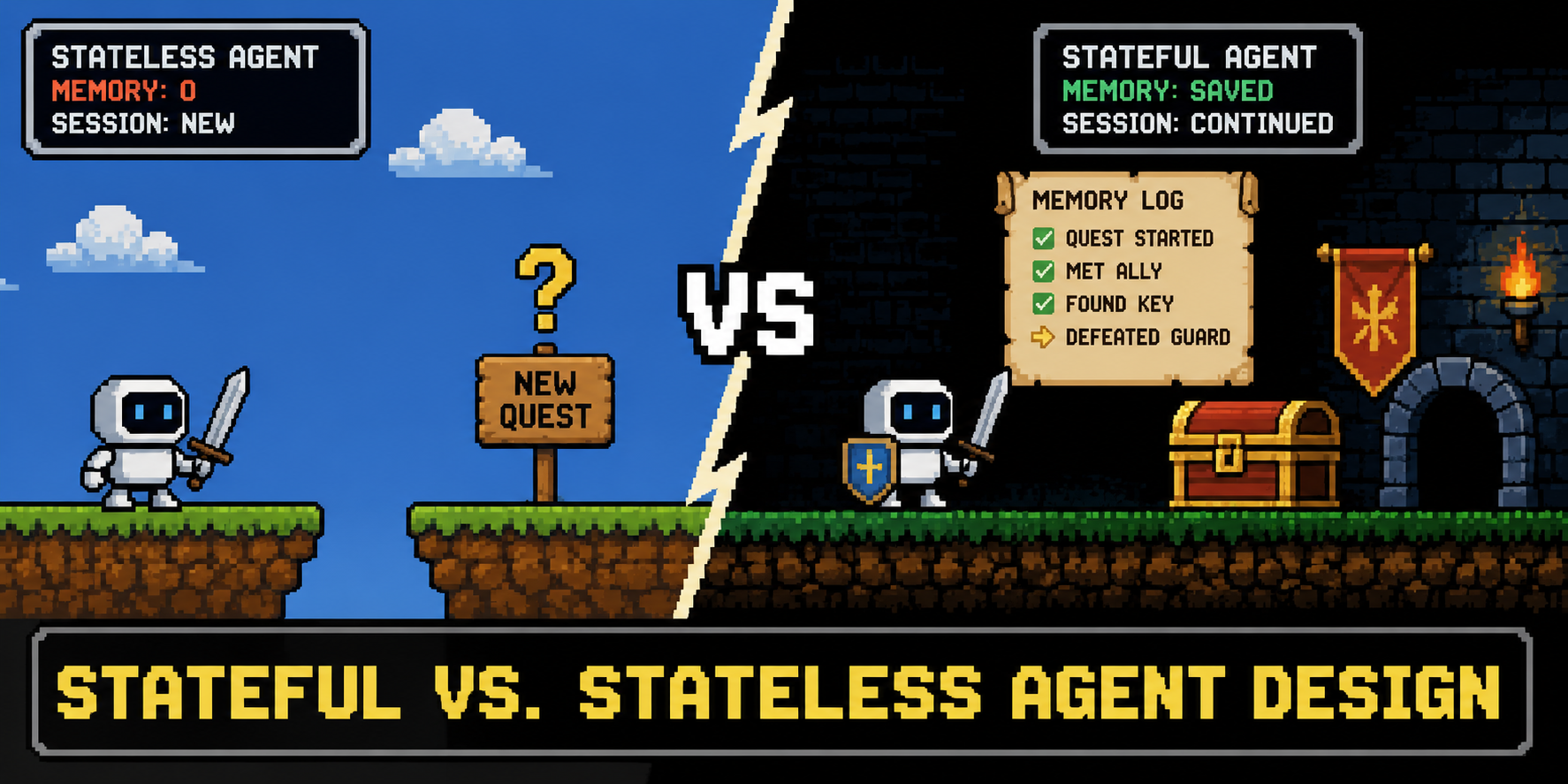
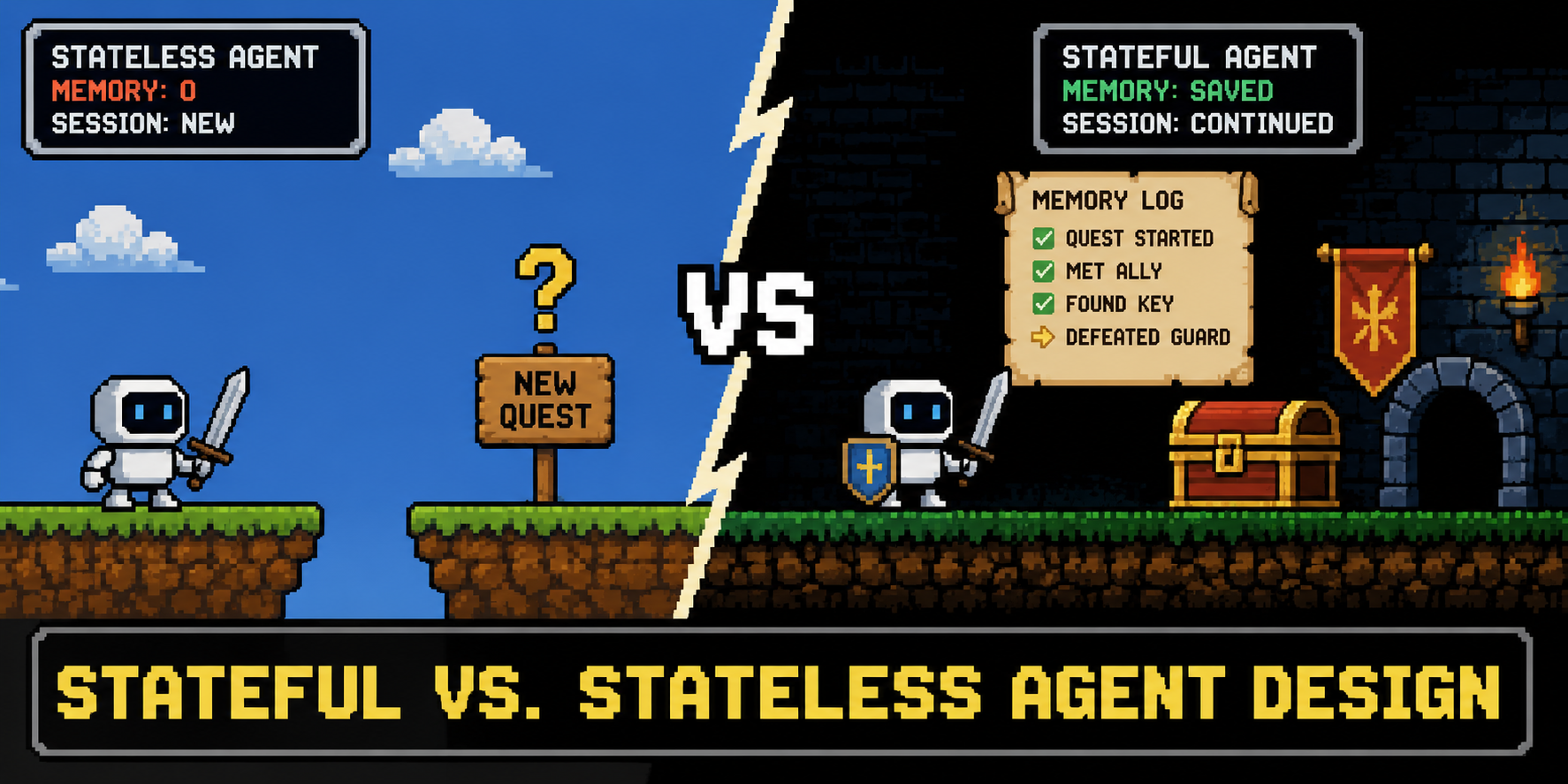
In this article, you will learn how an agent’s approach to managing state — stateless or stateful — shapes both its implementation and the deployment architecture built around it.
Topics covered include:
- What separates stateless from stateful agents, and the tradeoffs each design imposes on scaling.
- How to implement a stateless agent that depends entirely on the client to supply conversation history.
- How to implement a stateful agent that manages its own memory through a database layer.
Introduction
A previous article laid out a comprehensive architectural roadmap for AI agent deployment, examining the infrastructure needed to bring agents into production settings.
As a follow-up, we now turn to a fundamental, practical question that has to be answered before any load balancer is configured: where does the agent’s memory reside? Agents may handle their state (the context gained so far and the conversation history) in different ways, and this code-level decision can significantly impact the entire deployment architecture.
This article breaks down the two primary paradigms for handling an agent’s state: stateless and stateful design. A simplified version of a real-world implementation, using open language models served through the fast Groq API, will illustrate these ideas in practice.
Initial Setup
If this is the first time you are using language models from Groq in a Python program, you’ll need to install the required library: pip install groq.
After that, import it and set your Groq API key:
import os
from groq import Groq

# Get an API key in https://console.groq.com/keys and set it here
os.environ["GROQ_API_KEY"] = "PASTE_YOUR_GROQ_API_KEY_HERE"

# Initializing the client
client = Groq()

# Using an efficient model from Groq: Llama 3.1 8B Instant
MODEL_ID = "llama-3.1-8b-instant"
An important setup decision here is the choice of a specific model. llama-3.1-8b-instant is a highly cost-efficient model that is, at the time of writing, generously supported on Groq’s 2026 free tier: it allows up to 14,400 requests per day. That makes it an ideal choice for illustrating the stateless and stateful agent paradigms below.
Stateless Agents: Fire and Forget
Stateless agents treat each request as completely isolated and independent. The agent reads the user prompt, invokes the LLM inference engine, and delivers the output. Once that execution cycle ends, everything is forgotten.
The Tradeoff
Architectures based on stateless agents can be scaled horizontally with remarkable ease. Since no user memory is stored on a backend server, incoming requests can be forwarded to any available instance. There is, however, an important limitation in multi-turn conversations: the frontend must re-send the whole conversation history alongside every new request. As a result, the context window grows with a snowballing effect, quickly driving up token usage.
Illustrative Example
This runnable code illustrates, through a basic scenario, how a stateless agent typically interacts with a Groq language model.
First, we define a stateless_agent function that emulates an agent’s interaction with our chosen model. Importantly, no state or memory of the conversation is kept internally. Instead, the previous conversation history can optionally be passed in as a parameter and appended to the current prompt. The API call to the Groq model takes place in client.chat.completions.create().
def stateless_agent(prompt: str, provided_history: list = None) -> str:
    """
    The agent relies completely on the client to provide context.
    It retains no information from past interactions in local memory.
    """
    # Initializing with a system prompt
    messages = [{"role": "system", "content": "You are a helpful, concise assistant."}]

    # Appending whatever history the client provided
    if provided_history:
        messages.extend(provided_history)

    # Appending the new prompt
    messages.append({"role": "user", "content": prompt})

    # The LLM processes the entire chain of messages
    response = client.chat.completions.create(
        model=MODEL_ID,
        messages=messages,
        max_tokens=100
    )
    return response.choices[0].message.content.strip()
To understand the limitations of a stateless agent, we simulate a simple user-model conversation through it:
# --- Testing the Stateless Agent ---
print("--- Turn 1 ---")
prompt_1 = "Hi, my name is Alice and I am learning about API infrastructure."
response_1 = stateless_agent(prompt_1)
print(f"Agent: {response_1}")

print("\n--- Turn 2 (Without Client Context) ---")
# The agent fails here because it retained no memory of Turn 1
prompt_2 = "What is my name and what am I learning about?"
response_2 = stateless_agent(prompt_2)
print(f"Agent: {response_2}")

print("\n--- Turn 2 (With Client Context) ---")
# The frontend MUST inject the history into the payload for the agent to succeed
frontend_payload = [
    {"role": "user", "content": prompt_1},
    {"role": "assistant", "content": response_1}
]
response_3 = stateless_agent(prompt_2, provided_history=frontend_payload)
print(f"Agent: {response_3}")
The output demonstrates the core behavior of a stateless agent: without the client supplying prior conversation turns, the agent has no way to recall earlier context. When the full history is injected into the request payload, the agent can answer correctly — but the responsibility for managing and transmitting that history falls entirely on the client.
Stateful Agents: Persistent Memory
Stateful agents maintain their own memory across turns. Rather than relying on the client to resend history, the agent persists conversation state server-side — typically through a database layer — and retrieves it on each subsequent request.
The Tradeoff
Stateful agents provide a more natural conversational experience and reduce the payload size of individual requests, since history does not need to be retransmitted. The tradeoff is increased architectural complexity: the backend must manage session storage, and horizontal scaling requires that all instances share access to the same persistent store. This introduces dependencies on external systems such as databases or distributed caches, and adds latency from storage reads and writes.
Illustrative Example
The stateful agent implementation uses a dictionary to simulate a database, keyed by session ID. On each call, the agent retrieves the existing session history, appends the new message, queries the model, stores the updated history, and returns the response.
# Simulated database (in production, this would be Redis, PostgreSQL, etc.)
session_store = {}

def stateful_agent(session_id: str, prompt: str) -> str:
    """
    The agent manages its own memory using a session store.
    The client only needs to provide a session ID and the new prompt.
    """
    # Retrieve or initialize session history
    if session_id not in session_store:
        session_store[session_id] = [
            {"role": "system", "content": "You are a helpful, concise assistant."}
        ]

    history = session_store[session_id]

    # Append the new user message
    history.append({"role": "user", "content": prompt})

    # Query the model with the full history
    response = client.chat.completions.create(
        model=MODEL_ID,
        messages=history,
        max_tokens=100
    )
    reply = response.choices[0].message.content.strip()

    # Persist the assistant's response back to the session store
    history.append({"role": "assistant", "content": reply})
    session_store[session_id] = history

    return reply
Testing the stateful agent with the same scenario shows the contrast clearly:
# --- Testing the Stateful Agent ---
SESSION = "user-alice-001"

print("--- Turn 1 ---")
r1 = stateful_agent(SESSION, "Hi, my name is Alice and I am learning about API infrastructure.")
print(f"Agent: {r1}")

print("\n--- Turn 2 ---")
# No history is passed — the agent retrieves it from the session store
r2 = stateful_agent(SESSION, "What is my name and what am I learning about?")
print(f"Agent: {r2}")
Because the agent manages its own session history, the second turn succeeds without any history being supplied by the client. The client only needs to provide the session ID and the new message.
Choosing Between the Two Designs
The right choice depends on the requirements of the system being built:
- Stateless agents are well suited to applications where conversations are short-lived or single-turn, where horizontal scaling is a priority, and where the client layer can reliably manage and transmit history.
- Stateful agents are better suited to long-running, multi-turn interactions where continuity matters, and where the overhead of managing a shared session store is acceptable.
In practice, many production systems adopt a hybrid approach: stateless inference endpoints paired with an external session cache such as Redis, which gives them the scaling benefits of stateless design without forcing clients to carry the full conversation payload on every request.
Understanding where state lives — and who is responsible for it — is one of the earliest and most consequential decisions in designing a scalable agentic system.