Honest Review: Abacus AI's ChatLLM, DeepAgent, and AI Studio
Abacus AI offers 100+ models, autonomous agents, and creative tools in one subscription. Here's what it actually delivers.
Sponsored Content
The Biggest Challenge Teams Face With AI Today—and the Platform That Solves It
This is how the vast majority of teams currently use AI applications: one member subscribes to ChatGPT, another trusts Claude; the software developer uses an entirely different code editor, some marketer spends money on Midjourney, while the data team is building its own pipeline with raw APIs. In other words, everyone is working alone and separately, spending money on tools that duplicate each other and cannot be integrated.
This approach comes at a price. $20 monthly fee for ChatGPT Plus. $20 for Claude Pro. $20 for Gemini Advanced. $30+ monthly for image generation. Another $20 for a coding tool. This amounts to $100+ monthly per team member, without accounting for the time lost switching between tabs and re-explaining context to each tool separately.
And the price is not even the main problem. The problem is fragmentation. Each tool knows something about your work but is unaware of what the other tools know. You are copying the same document to three different tools. You are always repeating yourself. And whenever you need AI to do something beyond answering questions — completing complex tasks, building things, or operating autonomously in the background — most of those tools simply can’t do it.
This is the void that Abacus AI aims to fill, with an all-in-one AI platform rather than another chatbot. Whether the company lives up to its promises is what this review examines.
TL;DR — The Quick Version of Abacus AI
Before going deeper, here’s what you need to know upfront:
- One subscription instead of many: For $10 per month, you get access to 100+ top AI models including GPT-5.5, Claude Opus 4.8, Gemini 3.1 Pro, Grok 4.3, DeepSeek, Qwen, and others.
- More than a chatbot: Abacus AI includes agents that perform tasks autonomously, build applications, conduct research, and automate workflows without constant guidance.
- Always-on agents: Agents such as Abacus Claw and Hermes work 24/7 without interruption, even in offline mode.
- Developer suite: Abacus AI Desktop is a complete development environment with CLI, Code Editor, Listener, and CoWork modes, ranked among the top three globally in benchmarks.
- Creative tools included: Abacus AI Studio integrates 15+ image models and 12+ video models including Sora 2, Veo 3.1, Midjourney, and FLUX.
- Pricing: $10/month for Basic, $20/month for Pro with full agent access, and custom pricing for enterprises.
- Enterprise-grade security: SOC-2 Type 2 certified, HIPAA compliant, no training on your data.
- Known limitations: Learning curve, credits can deplete faster than expected under heavy workloads, and support response times vary.
- Best suited for: Developers, entrepreneurs, analysts, content creators, and enterprises looking to consolidate their AI stack.
What Is Abacus AI? One Platform, Every AI Tool
Abacus AI is best described as an all-in-one AI platform rather than a single AI product. It connects you to leading AI models worldwide while providing the infrastructure needed to put those models to work in a professional context.
The platform is built in two layers. The first is ChatLLM — a super-assistant aimed at everyday users. It serves as the interface layer for accessing models, analyzing documents, and generating images.
The second layer consists of agent and infrastructure tools: Abacus AI Agent (DeepAgent), Claw, Hermes, AppLLM, Desktop, Studio, SuperComputer, and RouteLLM. These handle the heavy lifting — multi-step task execution, continuous background operations, building and deploying apps, and hosting infrastructure for whatever you create.
What distinguishes Abacus AI is that both layers are included under the same subscription. The Basic package at $10 includes the interface layer plus agent access. The Pro package at $20 unlocks the full agent infrastructure layer.
The platform also scales to enterprise. Organizations use Abacus AI for MLOps, custom model training, real-time data pipelines, and department-wide AI deployment — all from the same company that offers a chatbot for $10 per month.
Who Owns Abacus AI and Is It Legitimate?
Abacus AI was founded in 2019, initially under the name RealityEngines.AI, by Bindu Reddy (CEO), Arvind Sundararajan (CTO), and Siddartha Naidu. All three founders come from senior technical roles at Google, Amazon, and Uber. Reddy led Forecasting and Personalization at AWS. Sundararajan ran the Autonomous Systems division at Uber. Naidu was one of the architects of Google BigQuery and Amazon fulfillment systems.
The company has raised over $90 million in funding from institutional investors including Eric Schmidt’s venture capital firm, Tiger Global, and Index Ventures.
Abacus AI is a legitimate company with credible founders, solid financial backing, and a production-grade platform that has been in active development since 2019. It is not a thin wrapper around existing APIs.
That said, “legitimate” does not mean “without faults.” Users have reported issues with the credit system, occasional agent errors, and inconsistent support response times — all of which are covered in more detail in the pros and cons section below.
Abacus AI Features: The Complete Product Ecosystem
ChatLLM — The AI Super-Assistant
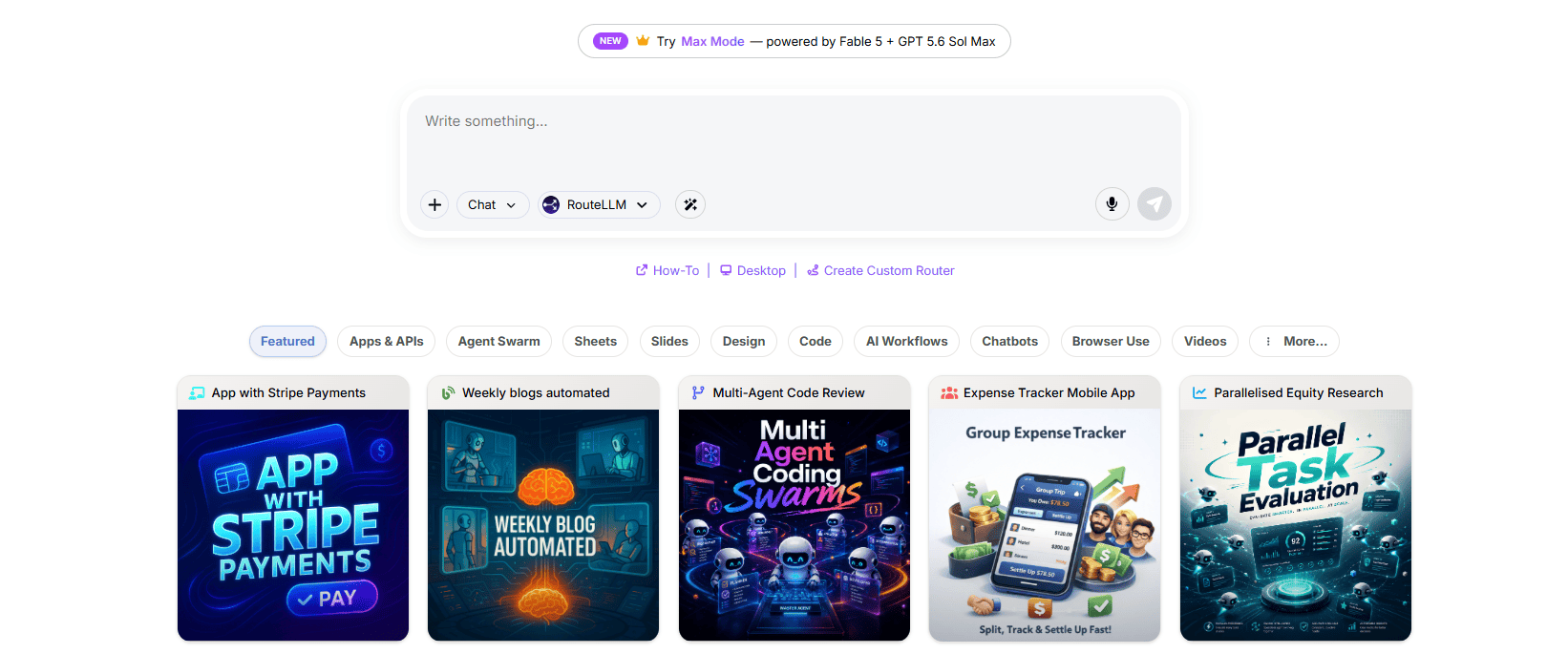
ChatLLM is Abacus AI’s primary user-facing application and where most users spend the majority of their time. The core idea is straightforward: instead of maintaining five separate AI subscriptions, access them all from one place.
Models currently available:
- OpenAI: GPT-5.5, GPT-5.5 Thinking, GPT-5.5 Pro, Codex 5.3, o3, GPT Image
- Anthropic: Claude Sonnet 4.6, Claude Opus 4.8
- Google: Gemini 3.1 Pro, Gemini 3.5 Flash
- xAI: Grok 4.3
- Open-source: DeepSeek v4, Qwen 3.7 Max, Kimi 2.7 Thinking, GLM 5.2, and 100+ others
New models are typically added within 24–48 hours of public release, which matters for teams trying to stay current with the model landscape.
What ChatLLM includes beyond chat:
- Document analysis: Upload PDFs, Word documents, PowerPoints, and images for AI analysis and commentary.
- Data analysis: Process CSVs and Excel files, create charts, and run exploratory data analysis.
- Image generation: GPT Image, Nano Banana Pro, FLUX Pro, Flux Kontext, Seedream, Recraft, Ideogram, DALL-E.
- Video generation: Through Abacus AI Studio — Sora 2, Veo 3.1, Kling AI v3, Seedance 2.0.
- Web search: Real-time search not limited by training cutoffs.
- Code Playground: Execute code snippets directly in chat.
- Text humanization: Rewrite content in professional, humorous, or conversational styles.
- Custom instructions: Save preferences and apply them across all conversations.
- AI Engineer: Build custom bots and AI agents without writing code.
- Team collaboration: Unlimited team members with shared projects and chat history.
- Enterprise integrations: Google Drive, Gmail, Google Calendar, Slack, Microsoft Teams, Confluence, and Jira.
- Mobile apps: iOS and Android with voice support, including a voice-only mode.
Usage limits are notably generous. ChatLLM allows thousands of text-based messages on top models before triggering rate limits — Abacus claims roughly 10x more tokens than competing services. Resource-intensive tasks like video generation or complex agentic workflows use a credit system, which requires monitoring for heavy users.
RouteLLM — Intelligent Model Routing
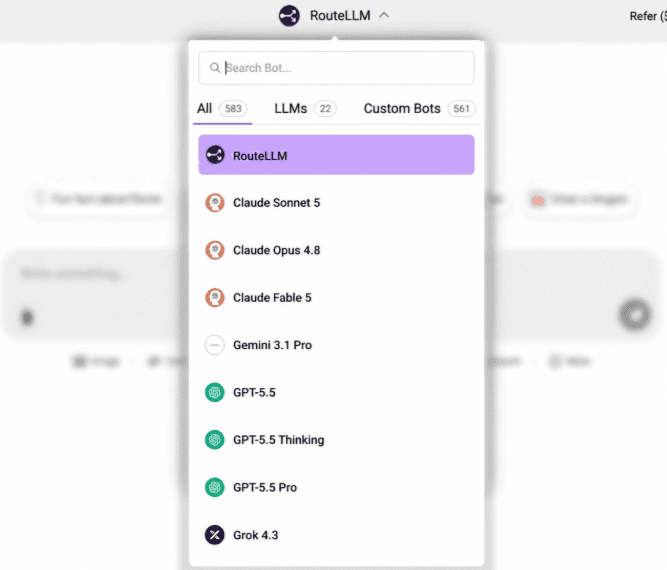
Most users don’t want to manually choose which AI model handles each task. RouteLLM solves this automatically.
It is an intelligent routing layer embedded in ChatLLM that analyzes your prompt and selects the most suitable model:
- Coding tasks → coding-optimized models (Codex 5.3, DeepSeek)
- Research and reasoning → reasoning-focused models
- Creative writing → generation-optimized models
- Complex multi-step tasks → the most capable available model
For developers, RouteLLM is also available as a standalone API. It provides a single unified endpoint to call any LLM — open-source or closed — with automatic failover, competitive pricing that matches or beats provider-listed rates, and high uptime. It is included with the ChatLLM subscription.
This is particularly useful for teams building AI-powered products who want flexibility without managing multiple API keys and integrations.
Abacus AI Agent (DeepAgent) — The Autonomous Executor
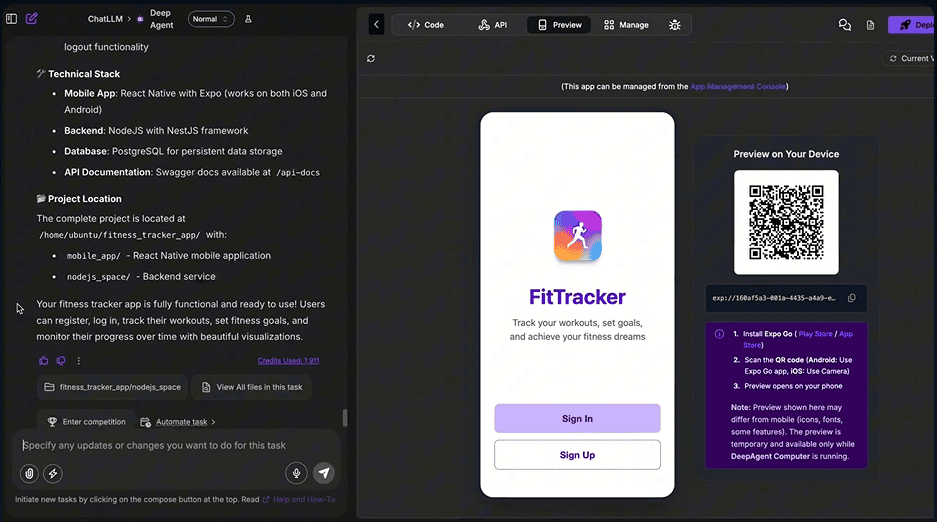
DeepAgent is a general-purpose autonomous agent that performs complex tasks rather than simply explaining them. This distinction matters: most AI products respond to questions; DeepAgent gets the work done.
It supports full application development workflows, multi-step research tasks, and end-to-end automation — operating with minimal hand-holding once a goal is defined. For teams that need AI to function as an active participant in a workflow rather than a passive assistant, DeepAgent represents one of the more capable implementations currently available on a consumer-accessible platform.