GPT-6 Astra Explained: Features, Benchmarks, and Comparisons
OpenAI's GPT-6 Astra adds computer use, persistent memory, and document generation. Here's what changed, the benchmark numbers, and where caveats apply.
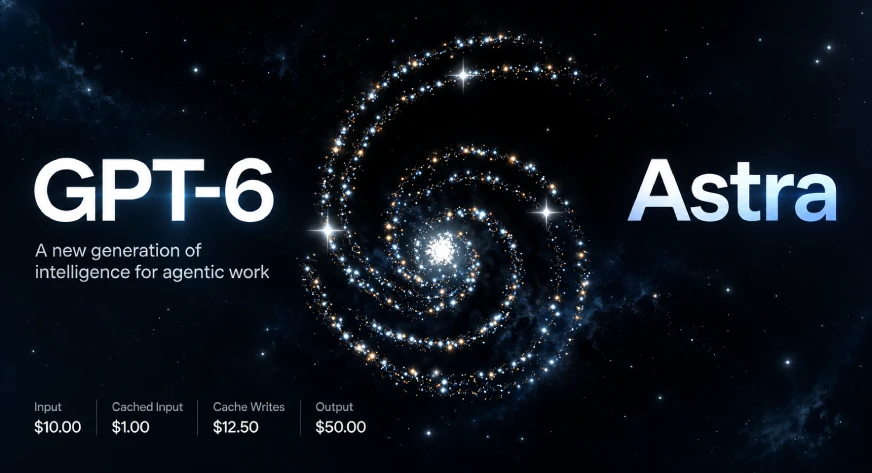
OpenAI has released GPT-6 Astra, its newest frontier model, less than a week after Anthropic’s Claude Fable 5.1. OpenAI calls Astra the world’s most intelligent and aligned model yet.
Astra is built to do more, not just answer more. It can use a computer to complete tasks instead of telling you how to do them. It can create finished documents instead of giving you a rough first draft. During long coding sessions, Astra can also remember what happened earlier instead of starting from scratch. And it’s better at knowing when to take action and when to stop and ask.
The bigger shift isn’t just smarter answers. AI is getting closer to actually getting the work done.
Some important caveats remain, though. Astra doesn’t beat every competing model, and some of its biggest benchmark numbers come with asterisks. Here’s what’s new, what Astra does well, and where the caveats are.
What Actually Changed in GPT-6 Astra
Drive a Computer End-to-End
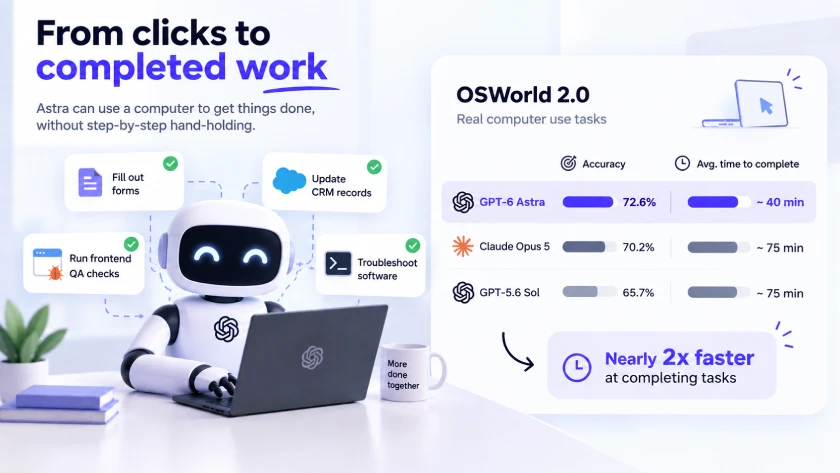
Astra can fill out forms, update CRM records, run frontend QA checks on a website, and troubleshoot software by watching what happens on screen, without step-by-step hand-holding. OpenAI reports a score of 72.6% on OSWorld 2.0, a benchmark for real desktop computer use, narrowly ahead of Claude Opus 5’s 70.2% and well ahead of GPT-5.6 Sol’s 65.7%.
Example: GPT-6 Astra can extract information from a W-2 and enter the relevant details into a Form 1040, helping automate routine tax-preparation work while leaving the final return for human review.
Knows When to Ask and When to Guess
Earlier models tended to either guess wrong on ambiguous instructions or interrupt with unnecessary questions. Astra is trained to fill in routine gaps on its own and pause only when the answer would meaningfully change the outcome.
OpenAI’s own side-by-side demo shows the difference: GPT-5.6 Sol built a personal career website on its own in about 13 minutes. Astra paused after 20 seconds to ask what career the user was actually moving into. That’s a small moment, but it’s a good illustration of the difference between a model that acts and a model that uses judgment about when to act.
Produces Finished Documents
There’s a meaningful difference between an AI that generates content and one that completes a deliverable. A generic model hands you text for a presentation. OpenAI says Astra is trained to match your existing templates, tone, and structure, and to pull in only the context that’s relevant rather than padding the output with everything it knows.
Astra builds a slide deck from just a handful of template slides while keeping the tone and layout consistent throughout. For teams that currently spend time reformatting AI output into a house style, that’s the part worth testing first.
Remembers Across Long Coding Sessions
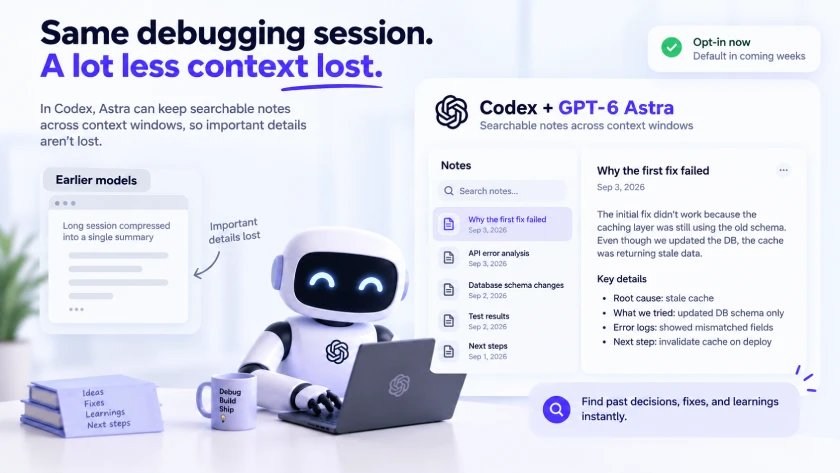
In Codex, Astra can now keep searchable notes across context windows instead of repeatedly compressing long debugging sessions into a single summary — a change OpenAI says preserves details that compaction tends to lose, like why an earlier fix failed. It’s opt-in for now through Codex’s config file, and OpenAI says it will become the default in the coming weeks.
Cybersecurity
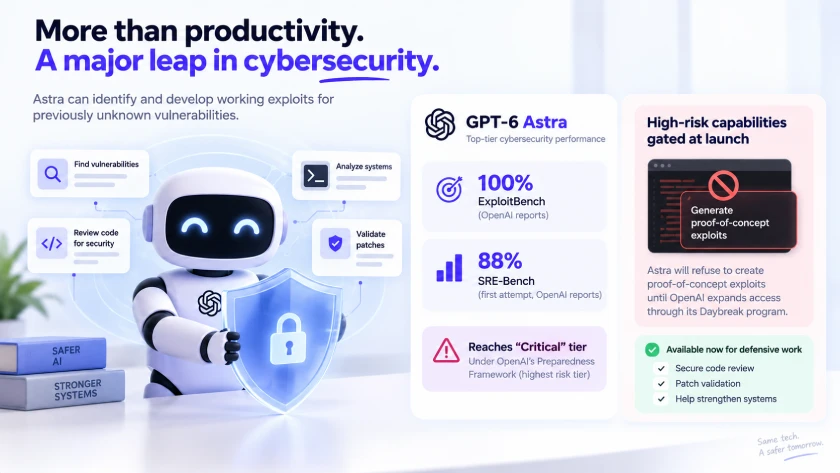
Astra’s biggest jump isn’t a productivity feature at all. OpenAI reports Astra reaches the “Critical” threshold for cybersecurity under its own Preparedness Framework — its highest risk tier — meaning the model can independently identify and develop working exploits for previously unknown vulnerabilities. OpenAI reports a 100% score on ExploitBench and says Astra solved 88% of SRE-Bench reverse-engineering tasks on the first attempt.
Because of that risk tier, OpenAI is gating the more dangerous parts of this capability at launch. Astra will help with defensive work like secure code review and patch validation, but it refuses to create proof-of-concept exploits until OpenAI expands access through its Daybreak program.
GPT-6 Astra Benchmarks
The table below pulls together the headline comparisons OpenAI published against GPT-5.6 Sol, Claude, and Gemini. All figures are self-reported by OpenAI in its launch materials.
| Benchmark | GPT-6 Astra | GPT-5.6 Sol | Claude Fable 5.1 | Claude Opus 5 | Gemini 3.8 Flash |
|---|---|---|---|---|---|
| OSWorld 2.0 (computer use) | 72.6% | 65.7% | — | 70.2% | — |
| FrontierMath Tier 4 | 97.6% | 83.0% | 87.8% | 73.2% | — |
| GPQA Diamond | 96.0% | 94.6% | 93.7% | 93.7% | 95.3% |
| Terminal-Bench 4.0 (coding) | 57.7% | 37.3% | 55.8% | 52.3% | 19.1% |
| ExploitBench | 100.0% | 78.5% | — | 70.0% | — |
| Humanity’s Last Exam (w/ tools) | 57.2% | — | 65.0% | 63.6% | — |
What this actually tells us:
- Astra’s clearest strength is computer use. It leads Claude Opus 5 on OSWorld 2.0 and does it in meaningfully less time per task.
- Its coding scores have improved substantially over its own predecessor, though the lead over Claude Fable 5.1 on Terminal-Bench 4.0 is narrow rather than decisive.
- It is not universally ahead of Claude. On Humanity’s Last Exam with tools, Astra scores 57.2%, behind both Claude Fable 5.1 (65.0%) and Claude Opus 5 (63.6%).
- Some headline numbers rely on evaluation setups that don’t reflect normal usage. Astra’s marketed 99.9% on ARC-AGI-3 depends on an expensive, stateful evaluation harness. Independent testing by the ARC Prize Foundation found that a standard, stateless API call scores far lower — somewhere between 17% and 63% depending on the reasoning tier used. Anyone calling the model through a normal API integration should expect the lower end, not the headline figure.
GPT-6 Astra vs Claude Fable 5.1 Comparison
As neither model is publicly available yet, early access reports from practitioners are the most useful signal available. The examples below highlight head-to-head comparisons shared by users testing both models on the same prompts.
Building a 3D Villa from a Single Prompt
Both models were given the same prompt to generate a 3D villa. The comparison shows differences in architectural detail, layout interpretation, and how each model handles spatial reasoning when translating a text description into a structured 3D output.
Designing a Travel App from the Same Prompt
Given identical instructions to design a travel app interface, the two models produced noticeably different results in terms of UI structure, feature prioritization, and visual hierarchy — illustrating how each model interprets open-ended product design briefs.
Video Prompt Generation
When tasked with generating prompts for video content, Astra and Claude Fable 5.1 differed in specificity, narrative structure, and the level of production detail included, which affects how directly the outputs can be handed off to a video generation pipeline.
Cost of GPT Astra
OpenAI has not yet published final API pricing for GPT-6 Astra. Based on positioning relative to GPT-5.6 Sol and the compute demands implied by its agentic capabilities, it is expected to sit at the higher end of OpenAI’s model tier pricing. Updated pricing will be reflected in OpenAI’s API documentation at launch.
Conclusion
GPT-6 Astra is a meaningful step forward in agentic capability, particularly for computer use, long-session coding, and document generation. Its benchmark lead over competitors is real in several areas but uneven — and some headline numbers depend on evaluation conditions that differ significantly from standard API usage. For practitioners evaluating Astra, the most reliable signal will come from testing it on tasks that match your actual workflows, rather than relying on any single benchmark figure.
Frequently Asked Questions
Q: What is GPT-6 Astra? GPT-6 Astra is OpenAI’s latest frontier model, designed for agentic tasks including computer use, long-context coding, and finished document generation.
Q: How does Astra compare to Claude Fable 5.1? Astra leads on computer use benchmarks and coding over its predecessor, but trails Claude Fable 5.1 on Humanity’s Last Exam with tools. The comparison is task-dependent rather than one-sided.
Q: What is the ARC-AGI-3 caveat? Astra’s marketed 99.9% on ARC-AGI-3 uses a stateful evaluation harness. Independent testing with a standard API call produced scores between 17% and 63% depending on the reasoning tier, which is more representative of real-world API usage.
Q: Is Astra’s cybersecurity capability restricted? Yes. Astra is rated “Critical” under OpenAI’s Preparedness Framework. Exploit generation is gated at launch and accessible only through the Daybreak program. Defensive use cases such as code review and patch validation are available without restriction.
Q: When will GPT-6 Astra be publicly available? OpenAI has not confirmed a general availability date. Access is currently limited to early testers, with broader rollout expected to follow the launch period.