ChatLLM by Abacus AI: Multi-Model AI Platform Review
ChatLLM by Abacus AI combines dozens of leading AI models, agents, coding tools, and automation into one subscription workspace.
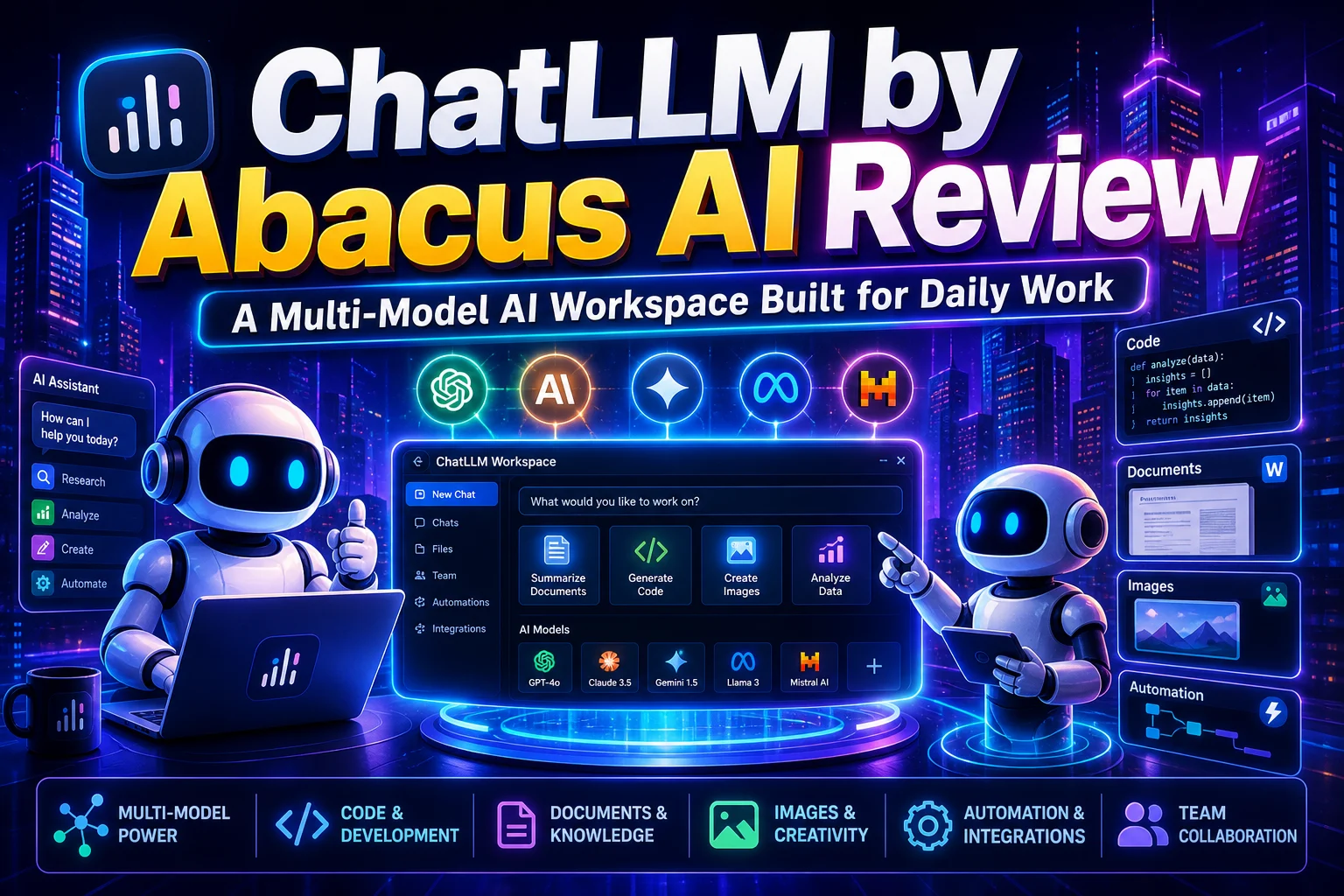
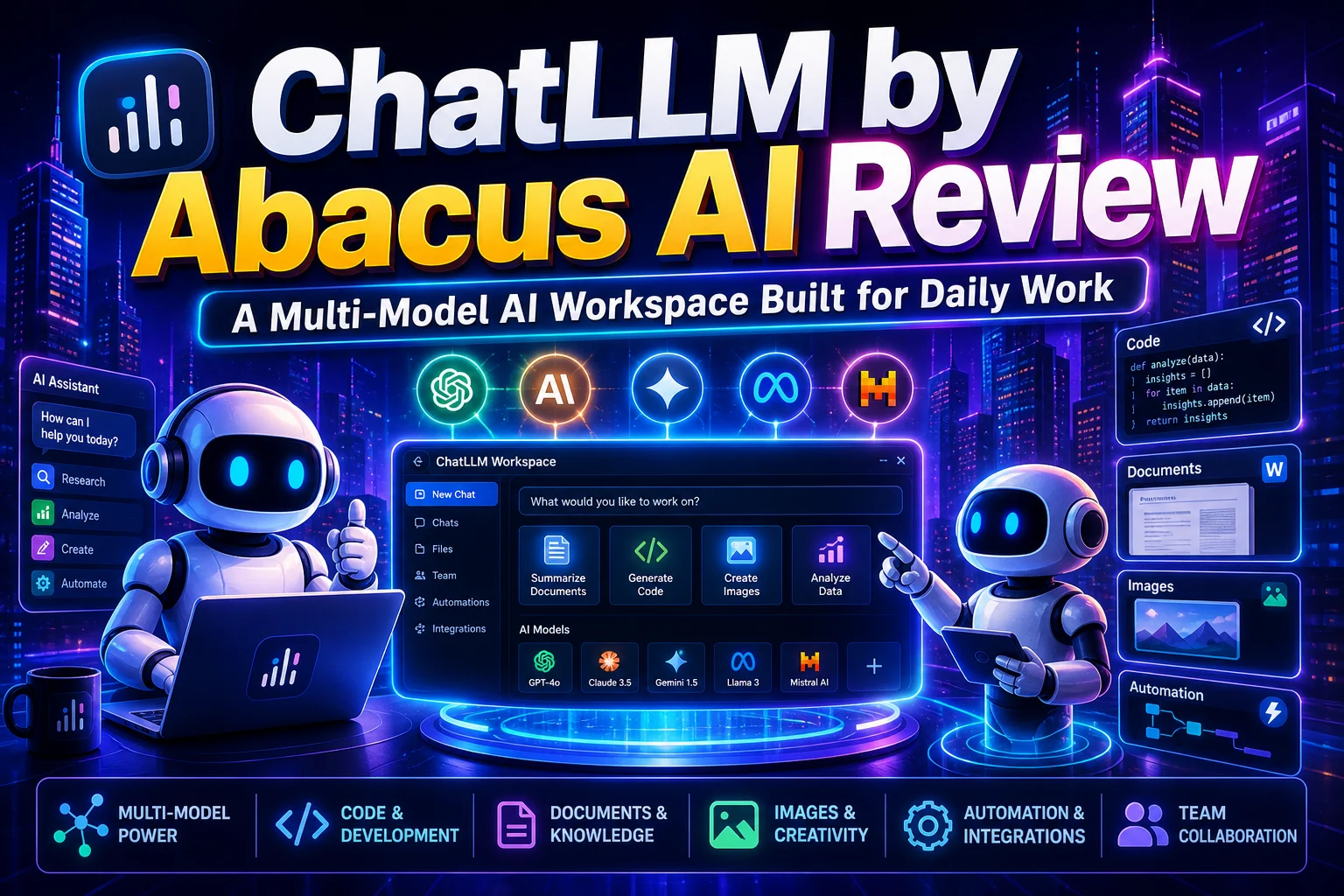
Artificial intelligence tools have become part of everyday work. Writers use them for research, developers use them for coding, marketers use them for content creation, and businesses use them to automate repetitive tasks.
The challenge is that most people end up paying for multiple AI subscriptions. One platform offers access to OpenAI models, another focuses on Claude, while a third specializes in image generation or AI agents.
This is where ChatLLM by Abacus AI takes a different approach.
Instead of offering access to a single AI model, ChatLLM brings together many of the world’s leading AI models under one subscription. The platform combines chat assistants, AI agents, coding tools, image generation, document analysis, automation, and collaboration features into a single workspace.
In this review, we’ll look at what ChatLLM offers, how it works, its strengths, limitations, pricing, and whether it’s worth considering in 2026.
TL;DR
- ChatLLM is essentially a hub that brings together many of today’s leading AI models, so you don’t have to juggle multiple subscriptions.
- Instead of being limited to one model, you can switch between GPT, Claude, Gemini, Grok, DeepSeek, Qwen, and others depending on the task.
- Beyond chat, the platform handles document analysis, coding, research, image creation, automation, and team collaboration.
- One thing that stands out is how much is included in a single subscription. You get access to AI agents, coding tools, integrations, and productivity features that would normally require separate services.
- Developers will appreciate the coding-focused models and the additional tools that come with Abacus AI Desktop and the coding agent.
- Teams can connect business tools such as Google Drive, Slack, Gmail, Teams, and Confluence to build custom workflows and AI assistants.
- The RouteLLM feature helps reduce guesswork by automatically selecting a suitable model for different types of tasks.
- For everyday use, the usage limits appear generous. Heavy activities like video generation, image creation, and large file processing consume more resources than regular conversations.
- Abacus AI says customer data is encrypted, not used for training, and protected through enterprise-grade compliance standards.
- At $10 per month after the introductory offer, the value largely depends on how many AI tools you use. People who regularly switch between models are likely to get more out of it than those who only rely on a single chatbot.
- Overall, ChatLLM feels less like a chatbot and more like an AI workspace designed for people who want multiple AI tools available in one place.
What Is ChatLLM? A Quick Overview of Abacus AI’s Multi-Model Platform
ChatLLM is an AI workspace developed by Abacus AI that provides access to multiple large language models (LLMs) from one interface.
Rather than choosing between ChatGPT, Claude, Gemini, Grok, DeepSeek, or Qwen, users can access all of them inside a single platform.
The platform also includes AI agents, document analysis, coding tools, image generation, workflow automation, and team collaboration features.
In simple terms, ChatLLM aims to be a single destination for most AI-related work.
A Beginner’s Guide to How ChatLLM Works
For beginners, ChatLLM works much like a standard AI chatbot.
For example:
- Use GPT-5.5 for reasoning and writing.
- Switch to Claude for long-document analysis.
- Use Gemini for research tasks.
- Use Codex for software development.
- Generate images with GPT Image or Flux.
- Run advanced workflows through AI agents.
Everything happens from one dashboard without needing multiple subscriptions.
If you’re brand new, here’s a simple mental model:
- Pick a task (write, research, code, analyze a file, create an image).
- Choose a model (or use routing — more on that later).
- Provide context:
- Paste text, instructions, or data
- Upload a file (PDF, CSV, PPT, image, etc.)
- Iterate:
- Ask for revisions
- Request a structured output (checklists, tables, drafts, plans)
- Operationalize (optional):
- Save outputs into your project workflow
- Turn repeated needs into a custom bot or agent
- Share with teammates
Which AI Models Can You Access Through ChatLLM?
One of ChatLLM’s biggest strengths is model diversity. The platform regularly updates its model library and adds newly released models shortly after launch.
Current model access includes:
OpenAI Models
- GPT-5.5
- GPT-5.5 Thinking
- GPT-5.5 Pro
- Codex 5.3
- o3
- GPT Image
Anthropic Models
- Claude Sonnet 4.6
- Claude Opus 4.8
Google Models
- Gemini 3.1 Pro
- Gemini 3.5 Flash
xAI Models
- Grok 4.3
Additional Models
- DeepSeek v4
- Qwen 3.7 Max
- Kimi 2.7 Thinking
- GLM 5.1
- Various open-source LLMs
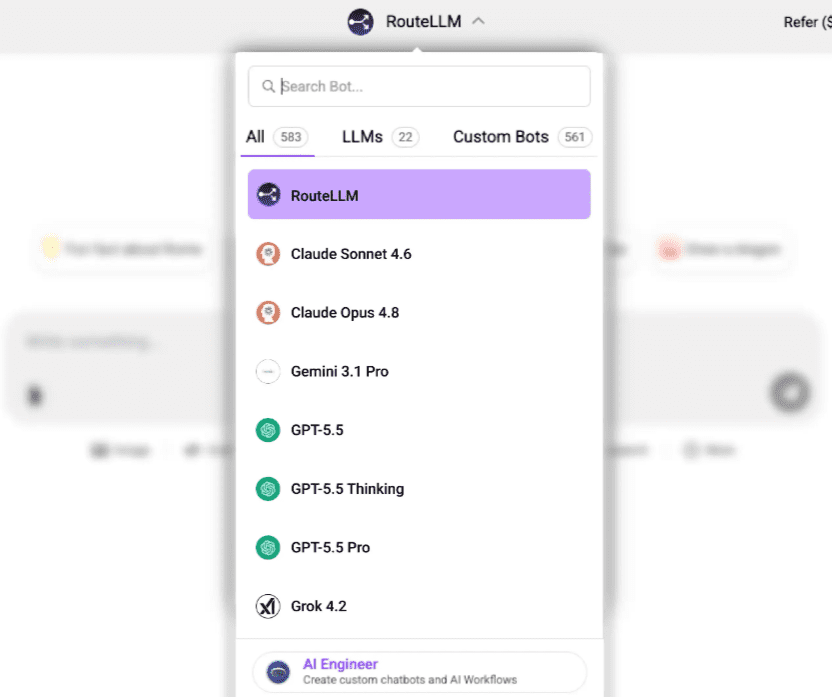
Having access to multiple models is useful because different AI systems excel at different tasks.
Complete Features of ChatLLM
ChatLLM is much more than a chatbot. It combines multiple AI capabilities within a single platform.
1. Multi-Model AI Chat
Access dozens of AI models without purchasing separate subscriptions.
2. Document Analysis
Upload PDFs, Word documents, PowerPoint files, images, and research papers. The AI can summarize, analyze, explain, and answer questions about uploaded files.
3. Data Analysis
Users can upload CSV files and Excel spreadsheets. The system can analyze data, identify trends, and generate charts.
4. Image Generation
ChatLLM supports several image-generation models including GPT Image, Nano Banana Pro, Flux Pro, Flux Kontext, Ideogram, Recraft, Seedream, and DALL·E. This allows users to create marketing visuals, illustrations, product concepts, and social media graphics.
5. Video Generation
Video creation is available through Abacus Studio using models such as Sora 2, Veo 3.1, Kling AI v3, and Seedance 2.0, expanding the platform beyond text and images.
6. Web Search
The platform can retrieve current information from the web, making it useful for research and fact-finding tasks.
7. Text Humanization
Users can rewrite content in different styles — professional, humorous, or caring — to adapt it for different audiences.
8. Custom Instructions
You can provide personal preferences, company guidelines, or project requirements that apply across conversations.
9. Code Playground
Generate and execute code directly inside the platform. This is useful for testing scripts, learning programming, and prototyping applications.
10. AI Engineer
The AI Engineer feature helps users build custom chatbots, AI workflows, and automated applications without extensive technical knowledge.
11. AI Agents
Users can create autonomous agents that perform recurring tasks and workflows.
12. Enterprise Integrations
ChatLLM supports connections with Google Drive, Gmail, Google Calendar, Slack, Teams, and Confluence, allowing AI to interact with business data and workflows.
13. Mobile Applications
Dedicated Android and iPhone applications provide access on the go, including voice capabilities.
Benefits of ChatLLM
After reviewing the platform, several advantages stand out.
- Access to Multiple Premium Models: Instead of paying separate subscriptions, users can access many leading AI models from one place.
- One Platform for Different Tasks: Writing, coding, image generation, document analysis, and automation can all be managed inside the same workspace.
- Frequent Model Updates: New AI models are added quickly after release.
- Useful for Teams: Collaboration features make it suitable for startups, agencies, and business teams.
- Automation Capabilities: AI agents reduce manual work by handling repetitive processes.
- Strong Security Focus: According to Abacus AI, user data is encrypted and not used for training. The company also states that it maintains enterprise compliance standards including SOC-2 Type-2 and HIPAA.
Does ChatLLM Have Usage Limits?
One of the biggest concerns with AI subscriptions is how much you can actually use the service before running into restrictions.
According to Abacus AI, ChatLLM offers more generous usage limits than many standalone AI platforms. Users can typically send thousands of text-based messages using popular models like GPT-5.5, Sonnet 4.6, and Gemini 3.1 Pro without hitting limits during normal usage.
However, ChatLLM also uses a credit-based system for resource-intensive tasks. Credits are consumed based on factors such as image generation, video generation, large file uploads, advanced AI workflows, and complex document processing.
Standard text conversations consume far fewer resources than multimedia or agent-based tasks. Users who frequently generate videos or work with large attachments may notice credits being used more quickly.
If a usage limit is reached, ChatLLM can automatically switch requests to another available model, helping users continue working without major interruptions.
For most freelancers, developers, marketers, and business users, the platform’s limits are unlikely to be restrictive during everyday use.
ChatLLM RouteLLM: How It Automatically Chooses the Best AI Model
One interesting capability inside ChatLLM is RouteLLM. Rather than forcing users to manually decide which AI model to use for every request, RouteLLM helps determine the most suitable model automatically.
For example:
- Coding tasks may be routed toward coding-focused models.
- Research tasks may use reasoning-focused models.
- Creative writing may use models optimized for language generation.
This reduces trial and error while improving efficiency. For beginners, it removes much of the complexity involved in choosing among dozens of available models.
Is ChatLLM Good for Coding?
Coding is one of ChatLLM’s stronger use cases. The platform includes dedicated coding-focused models such as Codex 5.3, a Code Playground for running scripts directly in the browser, and an AI coding agent designed for more complex development workflows. Users working on software projects can switch between reasoning-heavy models for architecture decisions and code-specific models for implementation, all without leaving the platform.