Top 7 Coding Models You Can Run Locally in 2026
Seven open-weight coding models worth running locally in 2026, from efficient MoE models to multimodal options, all tested on consumer GPU hardware.
Introduction
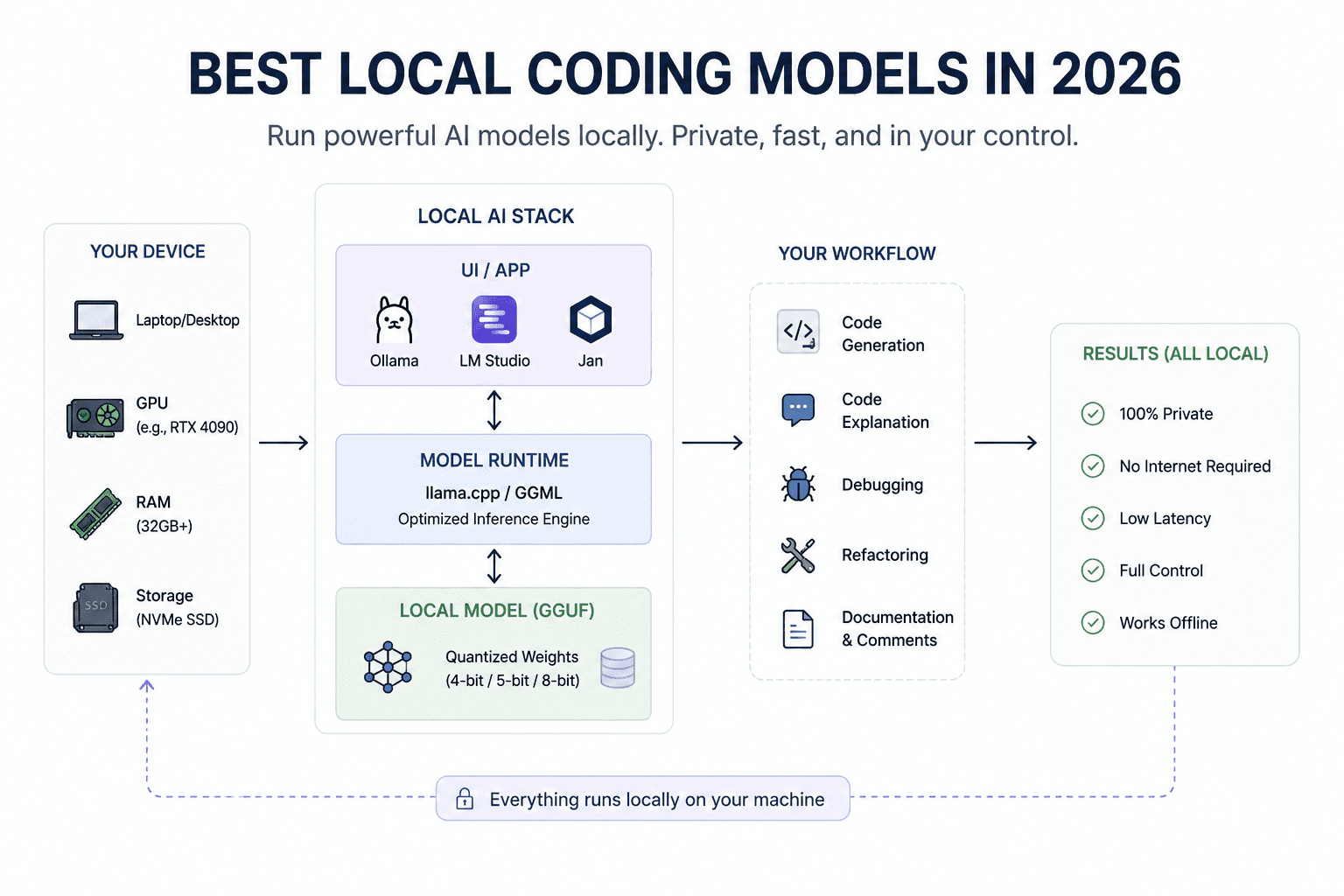
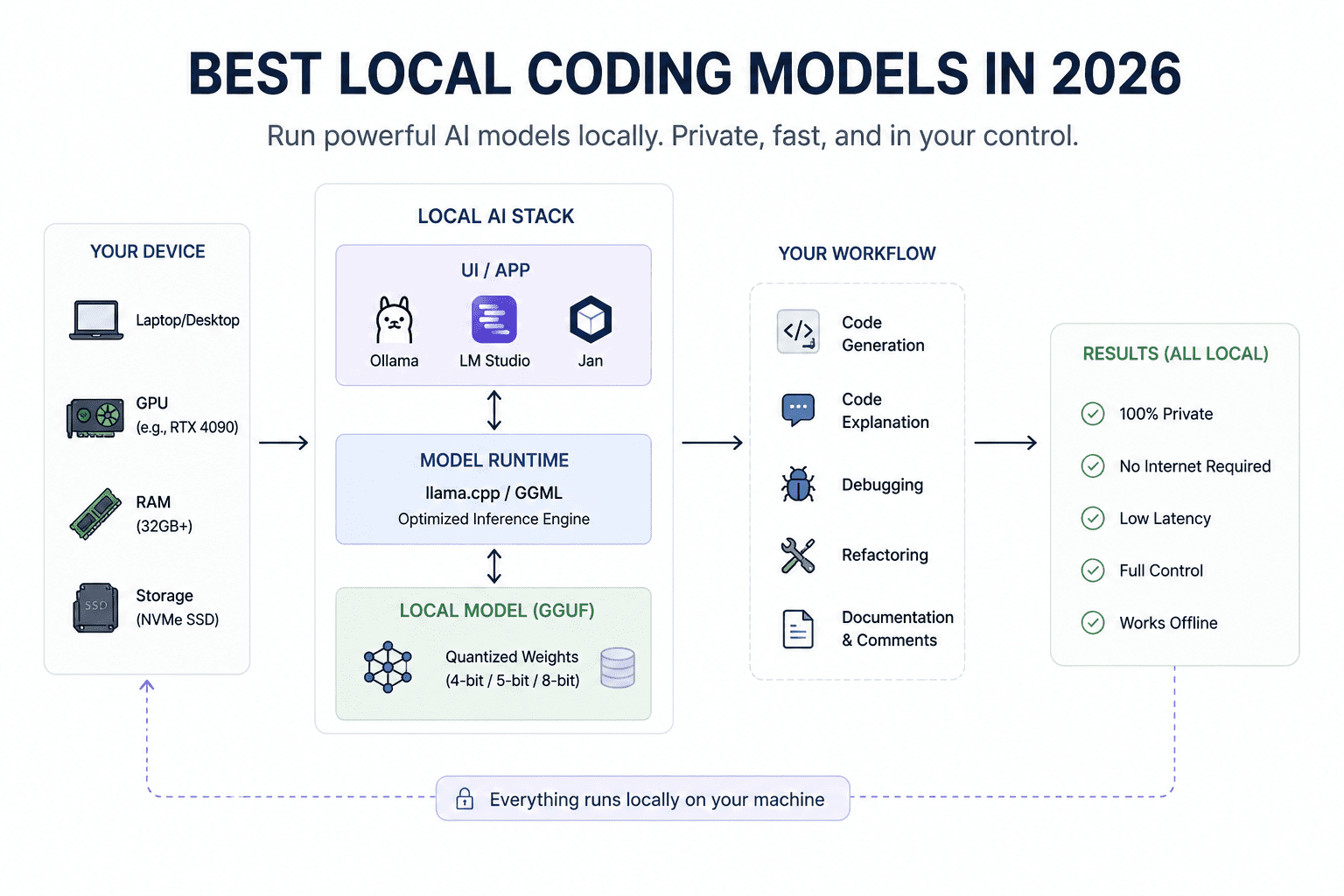
Local coding models are finally getting serious. This new wave of local large language models (LLMs), especially open models and community GGUF releases, makes them easier to run on consumer hardware. We are now at a point where some of these models can run on GPUs like an RTX 3090, generate fast enough to feel useful, and actually solve real coding and agentic programming problems. Not just demos. Not just gimmicks.
If you want a fully local coding setup and have at least 16GB of VRAM, these models can help you move away from relying only on Claude Code, Gemini, or other hosted coding assistants. They are fast, capable, private, and good enough for real development workflows.
You can already see this shift happening across the local AI community. Reddit’s r/LocalLLaMA is full of developers running local coding agents, testing GGUF models, building OpenAI-compatible local servers, and connecting these models to editors, terminals, and coding assistants.
1. Qwen3.6 27B MTP
Qwen3.6 27B MTP is easily one of the best local coding models available right now. It offers the best balance between size, speed, and actual coding ability. With GGUF quantized versions, you can run it on consumer hardware instead of needing a full cloud setup. Even with a 16GB to 24GB VRAM GPU, the 4-bit versions make local use realistic.
The r/LocalLLaMA community is already testing Qwen3.6 27B MTP for local agentic coding, faster inference, llama.cpp setups, and OpenAI-compatible local servers. Qwen models are strong at coding because they combine reasoning, instruction following, multilingual understanding, tool use, and long-context support. That makes Qwen3.6 27B MTP a strong all-round local model for coding assistants, repo chat, debugging, shell commands, and agentic workflows.
2. Gemma 4 31B IT QAT
Gemma 4 31B IT QAT deserves a serious place in any local coding setup. Google’s open Gemma models have always been good for people who want to run capable models locally, and this quantization-aware training (QAT) GGUF version makes it even more practical. You get a large 31B model in a 4-bit quantized format that is much easier to load on consumer hardware while still keeping strong quality.
Gemma 4 31B stands out because it is not only a coding model — it is also multimodal, which means it can help with screenshots, UI issues, diagrams, documentation images, and web app layouts while still being useful for code generation, debugging, and planning. The official benchmark numbers back this up, with strong coding results on LiveCodeBench and Codeforces. If you want a local model that can handle coding plus visual development tasks, Gemma 4 31B IT QAT is one of the best options to try.
3. DiffusionGemma 26B A4B
DiffusionGemma 26B A4B is one of the newest and most interesting models on this list. Instead of generating text in the standard autoregressive way, it uses a block-diffusion approach designed to improve generation speed by denoising blocks of tokens in parallel.
The main appeal is efficiency. DiffusionGemma has around 25B total parameters but only around 3.8B active parameters, so you get the benefit of a larger Mixture of Experts (MoE)-style model without paying the full inference cost of a dense 26B model. That architecture makes it particularly exciting for local coding: it could make local assistants much faster, especially for code generation, structured outputs, and quick reasoning tasks.
4. Nemotron Cascade 2 30B A3B
Nemotron Cascade 2 30B A3B is a 30B MoE-style model with only around 3B parameters active during inference. You are not paying the full cost of a dense 30B model every time, making it big enough to reason properly but still efficient enough to run on your own machine.
What makes this model stand out is that it feels more like a reasoning model than a simple coding autocomplete tool. NVIDIA describes it as strong for reasoning and agentic tasks, with both thinking and instruct modes, and claims gold-medal level performance on the International Mathematical Olympiad (IMO) 2025 and the International Olympiad in Informatics (IOI) 2025. For developers, that matters because coding is not just writing functions anymore — you want the model to debug, plan, review code, understand multi-step problems, and reason through implementation details.
5. Qwen3.5 9B MTP
Qwen3.5 9B MTP is the smallest model on this list, but it should not be underestimated. For its weight class, it ranks well and gives you a proper modern Qwen-style coding assistant without needing a large workstation. If you have a smaller local setup, this model is a practical choice. It is fast and much easier to run than the 27B or 31B models.
The GGUF version makes it even more useful for everyday developers. You do not need a complicated setup or expensive cloud instance to test it. You can run it locally, connect it to your editor or terminal workflow, and use it like a private coding assistant. It will not beat the bigger models on complex reasoning, but for daily coding tasks — small scripts, debugging, code explanations, shell commands, and quick local assistant workflows — it is more than enough. For people starting with local coding models, Qwen3.5 9B MTP is one of the safest and most practical choices.
6. EXAONE 4.5 33B
EXAONE 4.5 33B is LG AI Research’s open-weight multimodal model, and that makes it particularly useful for local coding workflows where you also need to understand screenshots, PDFs, diagrams, documentation, and UI layouts.
A lot of coding work now goes beyond writing functions. You are reading docs, checking errors from screenshots, understanding architecture diagrams, and working with messy project files. A model that can handle both text and visual input becomes much more useful in those situations. If you want a local model for code combined with documents, screenshots, and enterprise-style workflows, EXAONE 4.5 33B is a strong option to try.
7. North Mini Code 1.0
North Mini Code 1.0 is Cohere’s entry into the local coding model space. This is not a general chatbot that also happens to write code — it is built specifically for code generation, agentic software engineering, and terminal-based tasks, making it more focused for developers who want a local model for repo edits, command-line help, code review, and coding-agent workflows.
It is also a 30B-A3B model, meaning it has 30B total parameters but only around 3B active during inference. You get stronger reasoning than small models with better efficiency than a full dense 30B model. It may not be as broad as Qwen3.6 27B or Gemma 4 31B, but for coding-specific work, North Mini Code 1.0 is a very practical model to try.
Final Thoughts
This table gives you a quick view of which local coding model to pick based on your hardware, workflow, and coding use case.
| Model | Size / Type | Best Use Case | Why Pick It |
|---|---|---|---|
| Qwen3.6 27B MTP | 27B MTP | Strong local coding, reasoning, and agentic workflows | Best all-round local coding model |
| Gemma 4 31B IT QAT | 31B, 4-bit QAT, multimodal | Coding plus screenshots, UI bugs, diagrams, and long-context work | Strong coding benchmarks and multimodal support |
| DiffusionGemma 26B A4B | 26B / ~4B active | Fast, experimental local coding and reasoning | New architecture focused on efficient generation |
| Nemotron Cascade 2 30B A3B | 30B / ~3B active | Agentic coding, debugging, planning, and reasoning-heavy tasks | Feels more like a reasoning agent than autocomplete |
| Qwen3.5 9B MTP | 9B MTP | Smaller local machines and daily coding help | Fast, practical, and great for its weight class |
| EXAONE 4.5 33B | 33B multimodal | Code, documents, screenshots, PDFs, and diagrams | Best for document-heavy and visual coding workflows |
| North Mini Code 1.0 | 30B / ~3B active coding model | Local coding agents, repo edits, terminal tasks, and code review | Most coding-specific model in the list |
Local coding models are now good enough for real development work, not just testing or experimentation. If you have a capable GPU like an RTX 3090 or 4090, the best place to start is Qwen3.6 27B MTP in 4-bit — it remains the strongest all-round option for local coding and a solid foundation for building a fully private development workflow.